
Local properties under temperature
This application fits when yield strength, tensile strength and hardening must be understood not at room temperature but directly under elevated service temperatures.

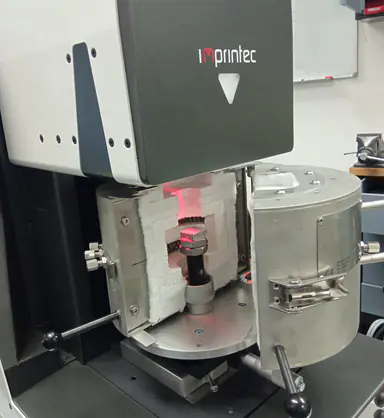
Application
High-Temperature Testing
i3D® for high-temperature testing and local material values: yield strength Rᶦₚ₀,₂, tensile strength Rᶦₘ and stress-strain curves under thermal conditions.
This application fits when yield strength, tensile strength and hardening must be understood not at room temperature but directly under elevated service temperatures.
Initial developments show good agreement with classical hot tensile tests, with significantly lower effort for local questions.
Component zones, weld areas and thermally highly loaded regions can be compared more selectively from a materials perspective than through global assumptions.
Aerospace, energy technology and high-performance mechanical engineering need such data when temperature strongly changes the mechanical statement.
The high-temperature module extends i3D® to stress-strain curves at elevated temperatures.
This makes local material characterisation possible under realistic thermal conditions instead of answering the question only through global room-temperature data.
The i3D® method has already been extended to temperature ranges above 400 °C. Initial tests show good agreement with classical hot tensile tests.
Especially for temperature-loaded components and weld areas, this opens a new way to classify strength profiles locally and close to the component.
With i3D®, temperature-related changes in yield strength, ductility and hardening can be captured with local resolution.
This is particularly relevant for understanding thermal load limits, local gradients and temperature-dependent safety margins in real component zones.
Further developments target temperature ranges above 1000 °C. This is a development status, not an already standardised serial function.
From a materials-testing perspective, exactly this distinction matters: already accessible temperature ranges deliver relevant added value today, while the expansion into extreme ranges opens further perspectives.
Contacts
If service temperature, weld area or a thermally highly loaded component zone determines the result, the testing route should directly fit temperature, material and target values.