
Many samples in a short time
Multiple samples and many measuring points can be characterised automatically within a compact time window instead of taking each variant through a full testing chain individually.

Application
Multi-Sample Screening
Multi-sample screening with i3D®: many measuring points, fast variant comparison, local properties and heatmaps for R&D, alloy development, additive manufacturing and QA.
Multiple samples and many measuring points can be characterised automatically within a compact time window instead of taking each variant through a full testing chain individually.
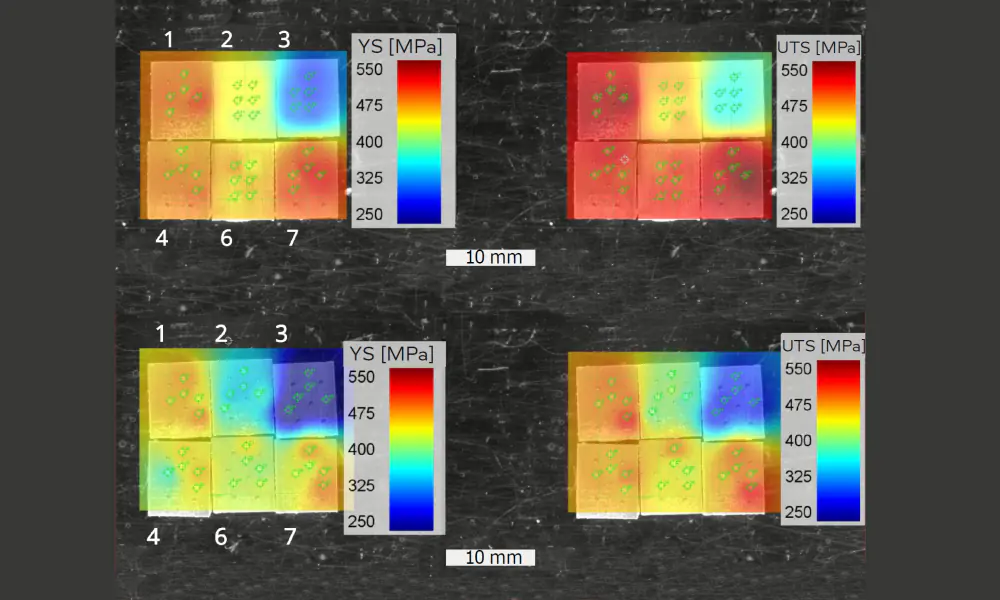
Yield strength Rᶦₚ₀,₂ and tensile strength Rᶦₘ become visible as local distributions across many samples and enable a robust ranking of conditions and batches.
LPBF, heat-treatment and alloy variants can be compared much earlier before only the best candidates move into deeper validation.
Multi-sample screening reduces preparation and testing effort per variant and accelerates decisions in materials development, R&D and QA.
Multi-sample screening brings many samples into one automated measurement campaign and makes mechanical differences visible quickly.
What matters is not the individual value, but the clean comparison of many conditions within one single screening run.
On 12 LPBF samples made of Scalmalloy®, 62 plastic stress-strain curves were characterised automatically within about one hour.
This is particularly relevant in additive manufacturing because process windows, microstructure, porosity, lack-of-fusion defects and heat treatment are closely coupled with later mechanical properties.
Complex process chains such as additive manufacturing need fast and reproducible testing methods to narrow down many conditions technically at an early stage.
Multi-sample screening does not replace every deep validation, but it shifts classification much earlier: first rank and understand, then deepen only the relevant candidates classically.
For materials testing and development, this application is particularly useful when local values, heatmaps and reproducible measurement sequences are needed for material ranking, process development or QA.
This turns many conditions into a technically readable variant matrix instead of an unstructured set of individual test reports.
Contacts
For many samples, conditions or parameter windows, a clean screening setup with clear point density, cycle logic and comparison structure is worthwhile.