
Directly on small geometries and the real component
This application fits when local zones on small components, fasteners, threads, shank areas or other difficult-to-access geometries must be evaluated from a materials-mechanics perspective.

Application
Component Testing
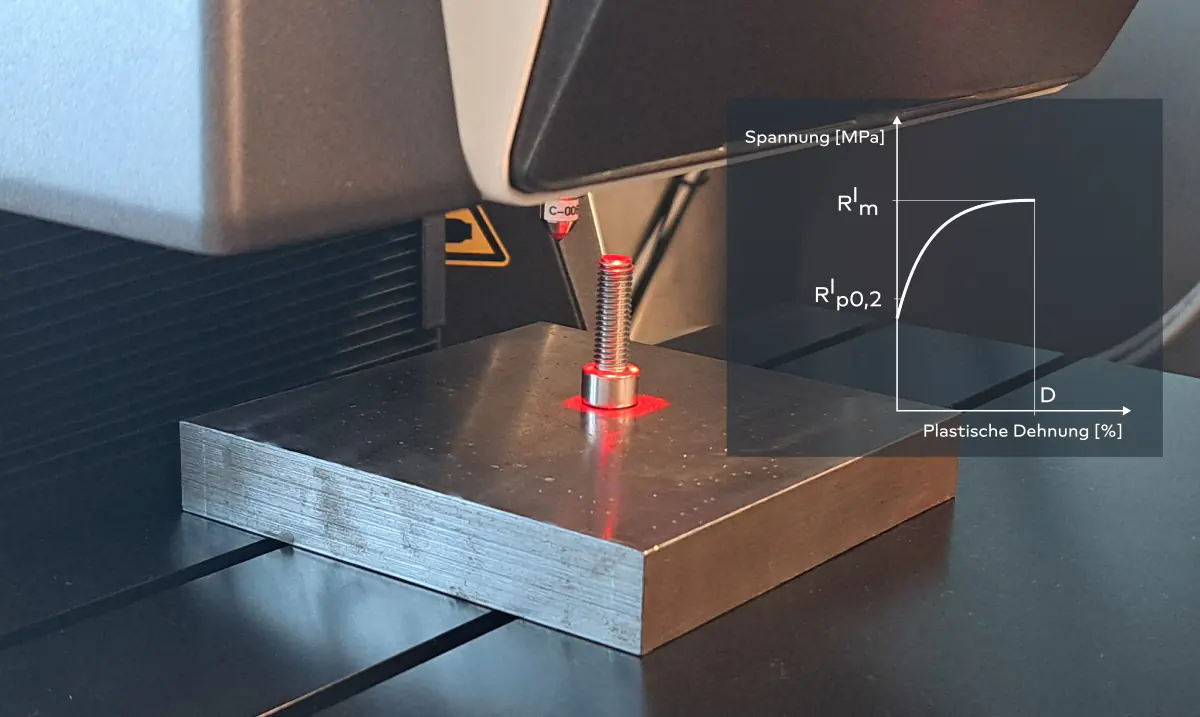
i3D® for component testing directly on small geometries, fasteners or local part areas: local yield strength Rᶦₚ₀,₂, tensile strength Rᶦₘ and further mechanical properties without a classical tensile specimen.
This application fits when local zones on small components, fasteners, threads, shank areas or other difficult-to-access geometries must be evaluated from a materials-mechanics perspective.
i3D® delivers local material properties related to Rᶦₚ₀,₂, Rᶦₘ, ductility and hardening instead of relying only on empirical hardness-strength correlations.
Testing remains small-area and component-near, without cutting, milling or transferring the relevant zone into a standardised tensile specimen.
Especially for small parts, fasteners, austenitic materials or local edge zones, the direct component statement is often technically more relevant than a global substitute specimen.
The i3D® method evaluates mechanical properties directly on small geometries, fasteners and real component zones without first having to transfer them into a classical tensile specimen.
From a materials-testing perspective, what counts is the local statement at the technically relevant location. Screws are a typical example, but not the only meaningful use case.
Yield strength Rᶦₚ₀,₂, tensile strength Rᶦₘ, ductility and hardening behaviour are the central results of the method.
For the materials-testing classification, it is important that these values do not come from a hardness conversion, but from the local indent and evaluation logic of the i3D® method.
Threads, notch radii, coatings, local forming zones and small cross-sections make small parts and fasteners particularly demanding for classical tensile specimens and standard samples.
That is exactly why local, component-near materials testing is technically valuable here: the relevant zone is evaluated directly instead of being approximated only by a global substitute route.
Quality assurance, material development and failure investigation are typical fields for this application because small parts and fasteners often need to be evaluated locally exactly there.
If failure starts in a small zone, a globalised testing statement is often not the technically best answer.
Contacts
If small geometry, fastener, coating or a local problem zone defines the material question, the testing route should fit geometry, material and target values directly.