Why DIN SPEC 4864 matters
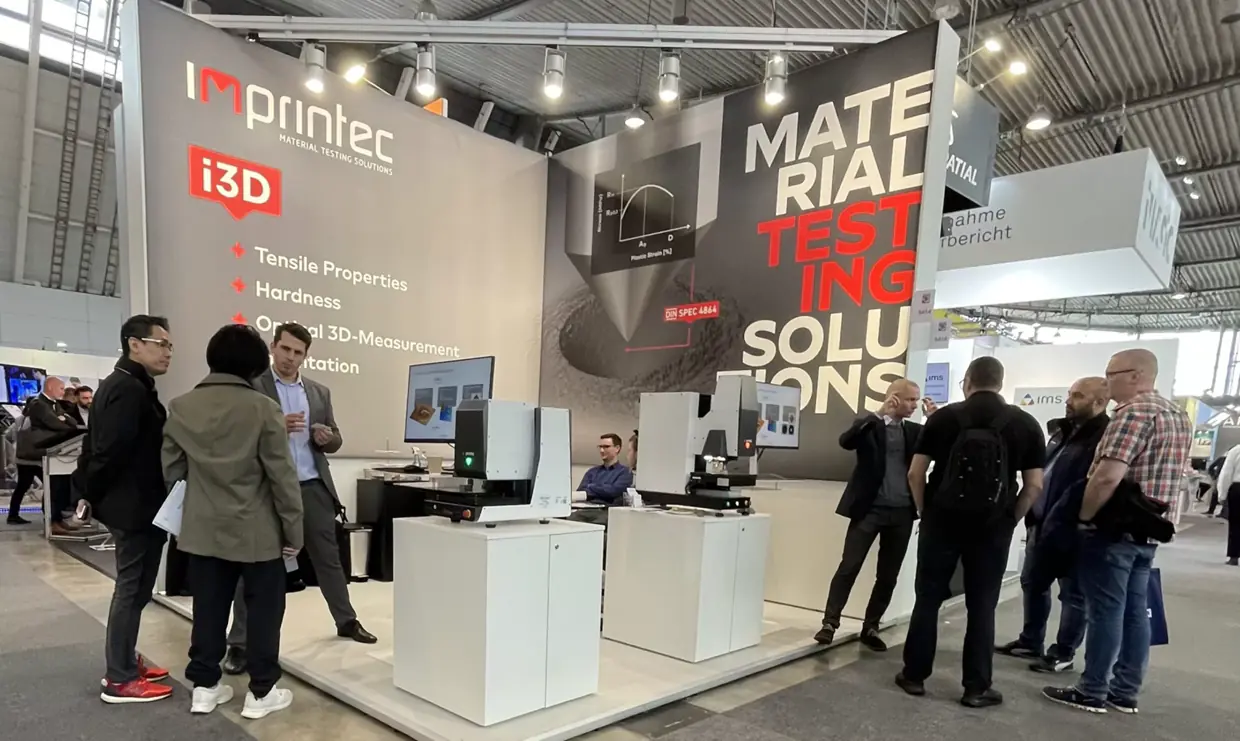
DIN SPEC 4864, together with ASTM E3499, is the core reference framework for the i3D® Imprint Test when local plastic material properties are derived from an indentation, a measured 3D indent geometry and inverse model-based evaluation. It gives the method a defined workflow instead of leaving it as a loosely described lab procedure.
For users in development, laboratory and quality assurance, DIN SPEC 4864 and ASTM E3499 matter because they clarify what the method is designed to do, which outputs are meaningful and under which technical conditions results remain comparable.
- reference framework for the i3D® indentation route
- clearer scope, outputs and methodological boundaries
- stronger basis for defensible local material data
What DIN SPEC 4864 covers technically
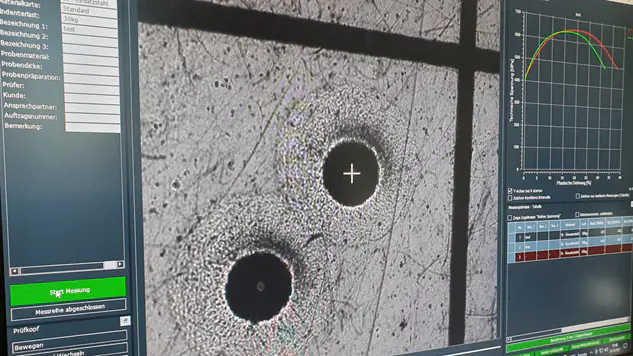
DIN SPEC 4864 covers the complete chain from the force-controlled indentation to the optical 3D acquisition of the test indentation and the inverse FEM-based evaluation. ASTM E3499 complements this with an ASTM-oriented view on testing procedure, evaluation logic and reporting. Together they define specimen condition, indenter geometry, testing procedure, environmental conditions and verification logic much more clearly.
The aim is not just to describe a machine setup, but to define a reproducible route for deriving stress-strain data and comparison values aligned with the mechanical logic of tensile testing.
- scope of application for plastically deformable metallic materials
- requirements on specimen surface, thickness and test volume
- indenter geometry and force-controlled testing procedure
- 3D measurement of the test indentation including pile-up geometry
- inverse evaluation and verification logic for reproducible results
Why DIN SPEC 4864 is relevant in practice
DIN SPEC 4864 becomes especially valuable when local yield strength, tensile strength and flow behaviour must be assessed on real parts, small geometries or critical zones where conventional tensile specimens are impractical. Together with ASTM E3499, it helps users distinguish between a meaningful local test task and an overstated method claim.
For Imprintec, DIN SPEC 4864 and ASTM E3499 are the technical basis for standard-related discussions, practical implementations and comparison measurements. This is where standard-oriented indentation testing becomes operational for industrial projects.
- local material data on welds, heat-affected zones and additive structures
- reduced specimen preparation compared with classical tensile routes
- clearer basis for reports, benchmarking and customer communication
- useful bridge between laboratory validation and industrial application