
Testing closer to the process
The material statement moves out of a late laboratory route and closer to manufacturing, component flow and production-near quality assurance.

Application
Inline Testing
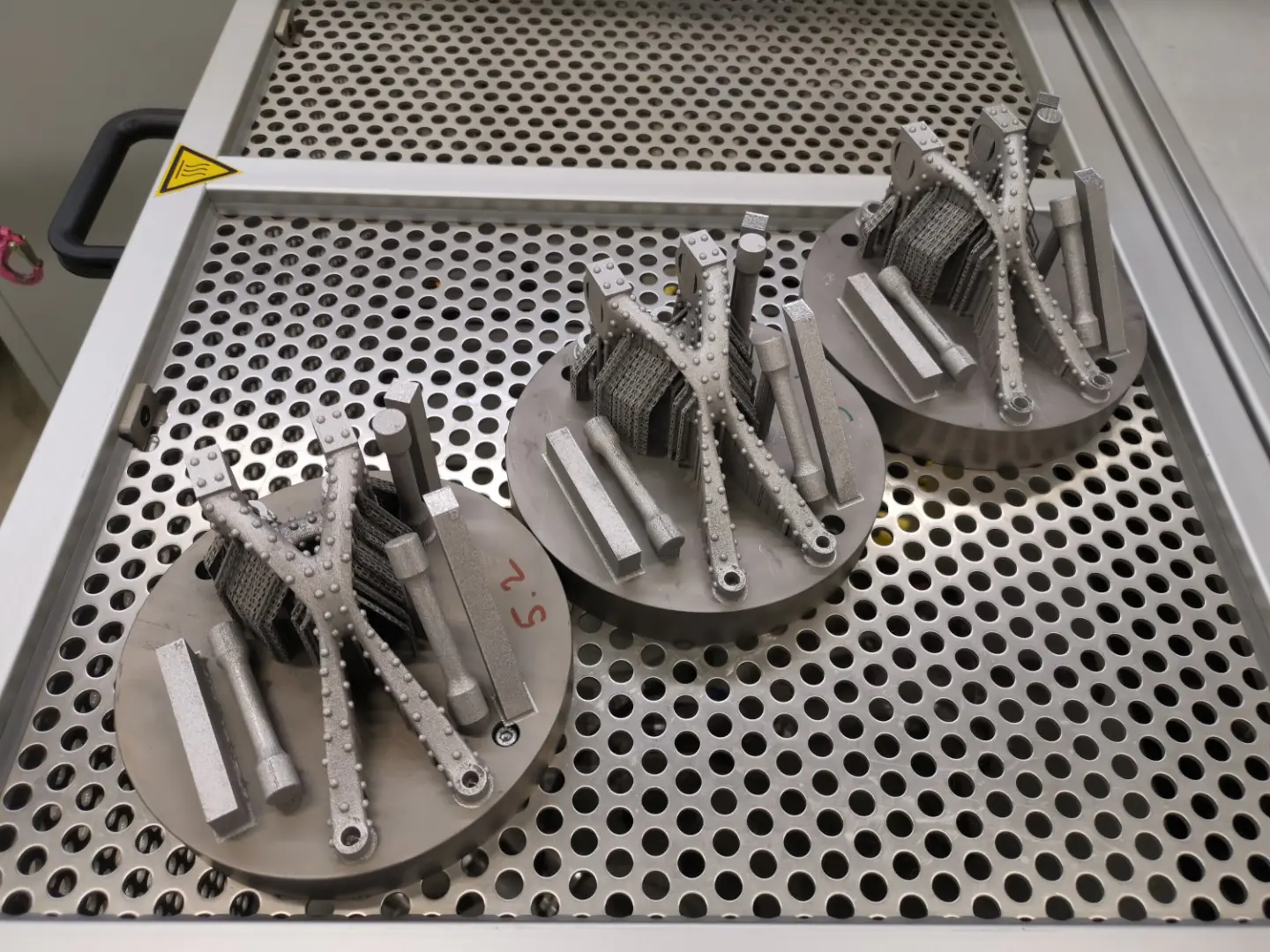
Inline QA with i3D® for additive manufacturing and process-near materials testing: robot-assisted testing, local material properties and automated component evaluation in the manufacturing environment.
The material statement moves out of a late laboratory route and closer to manufacturing, component flow and production-near quality assurance.
A testing module can be connected to a six-axis robot and integrated directly into process-near component evaluation.
Especially for 3D-printed components, process data, geometric defects and local mechanical properties jointly determine the real component quality.
Local deviations become visible earlier and can be fed back faster into release decisions, process adjustment or serial decisions.
Inline QA here is clearly focused on additive components and process-near quality assurance within the Enabl3D project.
The focus is on an economical and reliable testing method for 3D-printed components that makes local material properties measurable directly in the manufacturing environment.
The solution was developed together with Fraunhofer IPA, Fraunhofer IAPT and VisiConsult in the BMWK-funded Enabl3D project.
The combination of indentation testing, high-resolution process monitoring and µCT analysis creates a multi-stage testing method that combines local material properties and defect locations.
The testing module can be connected to a six-axis robot. This allows fully automated testing directly in the production line.
From a materials-testing perspective, this matters because not only the measurement itself counts, but also the reproducible integration into real manufacturing cycles, component handling and release logic.
Aerospace, automotive and medical technology are typical fields in which additive manufacturing is expected to grow from prototyping to serial production.
Inline QA becomes interesting there when mechanical safety and economic efficiency must be fulfilled at the same time.
Contacts
If robotics, serial logic, additive manufacturing or release requirements define the testing route, integration should be coordinated technically and cleanly at an early stage.