
Local values directly at weld and HAZ
Rᶦₚ₀,₂, Rᶦₘ and local stress-strain data are determined exactly where the welded joint is actually critical: in the weld, the heat-affected zone and the transition.

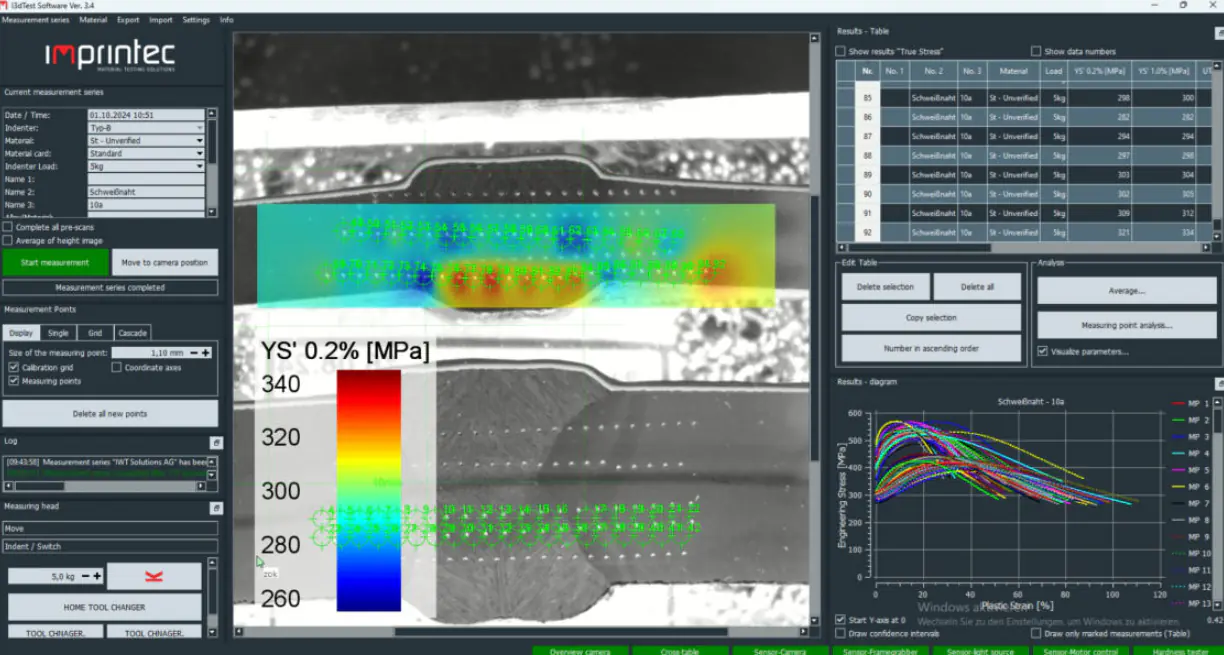
Application
Weld Testing
i3D® for weld testing directly in the weld seam, heat-affected zone and transition: local yield strength Rᶦₚ₀,₂, tensile strength Rᶦₘ and stress-strain curves without a tensile specimen.
Rᶦₚ₀,₂, Rᶦₘ and local stress-strain data are determined exactly where the welded joint is actually critical: in the weld, the heat-affected zone and the transition.
Weld passes, heat input, filler material, parameter windows and local microstructural transitions can be compared more selectively than through a purely global average-value route.
When the real question sits in the weld zone, the effort for specimen transfer, preparation and idealised substitute geometries becomes much smaller.
Weld evaluation in development, materials testing, quality assurance and component analysis becomes more accurate when local material behaviour is technically decisive.
The i3D® method is based on the force-controlled indentation of a diamond body into the material to be tested. This creates a small, precise indent with a minimal influence zone and a clearly local statement.
Unlike classical hardness testing, the indent is measured fully in three dimensions and evaluated by means of inverse finite-element analysis. This makes it possible to derive locally resolved stress-strain curves and local material properties.
Key mechanical properties such as yield strength Rᶦₚ₀,₂ and tensile strength Rᶦₘ can be determined directly on the real component, quickly, with low damage and with local differentiation.
Access to plastic material properties is therefore no longer limited to standard-compliant tensile specimens, but can take place directly on the weld seam, in the heat-affected zone or at critical structural details.
This makes real screening of welded joints possible, with quantifiable evaluation of strength, yield strength and material condition in the weld area.
Especially for transitions, HAZ widths, weld passes or process-related inhomogeneities, local differentiation is often more meaningful than a global specimen far away from the actual zone.
Typical fields of application are load-bearing steel structures, bridge components, crash-relevant vehicle structures, aerospace components and safety-critical welded joints in defence and marine environments.
Wherever failure starts locally and the weld seam or heat-affected zone determines component performance, local materials testing provides the technically more relevant view of the joint.
i3D® testing delivers highly resolved mechanical properties directly on the component and closer to the actual weld zone than a classical global testing route.
Combined with 3D surface measurement and FEM-supported evaluation, this creates a powerful tool for the modern assessment of weld seams, especially when mapping, local gradients or fast comparability are required.
Contacts
If weld parameters, heat-affected zone, component geometry or release requirements define the evaluation, a measurement strategy matched directly to the real joint is worthwhile.